With deep sadness we announce the passing of Angelis Hagias, who departed this life in the early hours of Friday, 28 November 2025, in Adelaide, at the age of 86.
Angelis was born on 20 July 1939 in Karitsa and spent his childhood in Karitsa and Vlachioti, Laconia. At the age of 25 he migrated to Australia, arriving on 22 February 1965, where he built his life and raised his family.
The funeral service will be held on Wednesday, 3 December 2025, at 11:00 a.m. at the Church of St George, Thebarton. Interment will take place at Centennial Park Cemetery.
His loss leaves a profound void in the hearts of his family, relatives, fellow villagers, and all who had the honour of knowing him.
He is survived by his wife, Alkithea, his five children, his seven cherished grandchildren, and his first great-grandchild.
We extend our heartfelt condolences to his family.
May his memory be eternal.
Ενημερωτικό Δελτίο του Παλλακωνικού Συλλόγου Νότιας Αυστραλίας «Ο Λεωνίδας» [Πολιτιστικός - Προοδευ
Saturday, 29 November 2025
Vale Angelis Hagias (1939-2025)
Friday, 28 November 2025
Discovering “Parnonas and Its Villages”: A Quiet Treasure on the Internet
A quiet corner of the internet brings memory, landscape and village life together with remarkable warmth, offering Laconians everywhere a window into the mountain rhythms and shared heritage of Párnonas.
From time to time, a corner of the internet offers something unexpectedly rich, a place where memory, landscape, and village life gather with real warmth. One such corner is the Facebook page “O Párnonas ke ta Choriá Tou”, meaning “Parnonas and Its Villages” (hosted at facebook.com/Mariskevis). Though rooted in the Arcadian village of Mari and guided largely by Sotiris Skevis, president of the local cultural association, its reach extends far beyond the mountain itself. For Laconians and their descendants scattered across the world, the page offers a vivid introduction to a neighbouring region whose history, nature, and rural rhythms so often echo our own.
A Mountain That Shapes Two Worlds
Parnonas, the long ridge that stradles Arcadia and Laconia, has shaped the character and fortunes of communities on both sides. Its villages, built of stone, set on terraces and surrounded by forests of fir, pine, chestnut and oak, feel instantly familiar to anyone with roots in the Laconian countryside. Life here has always followed patterns that Laconians recognise: seasonal work, respect for the land, close ties with animals and fields, and a quiet but enduring sense of community.
What the Page Brings to Life
The Facebook page captures these threads with affection and great attention to detail. Through the lens of Sotiris Skevis, readers encounter Mari under a luminous full moon, olive trees that have stood for more than a thousand years, forgotten forest paths linking one village to the next and glimpses of everyday life in Karitsa, Kosmas, Agios Petros and other mountain villages. The posts do not seek to impress with polish or spectacle. Instead, they feel like a local friend guiding you to the corners that matter, the light that falls just so across a winter field, the church steeple half hidden among branches, the bend in the path that leads to childhood memories.
Why It Matters to Laconians Everywhere
For Laconians living far from the homeland, the page has a particular charm. Its images and small stories evoke a world that feels at once familiar and new. The stone houses, the narrow lanes and the mountain monasteries echo the landscapes many of us grew up with, while the neighbouring villages of Parnonas add a fresh perspective. For the younger generations abroad, who may know Laconia mainly through family tales or brief visits, the page provides a gentle doorway into the wider cultural and geographical landscape of our region.
Even those who live permanently in Laconia may find the page unexpectedly rewarding. It serves as a reminder that the Peloponnese contains not only its famous ancient sites and beaches but also a quieter wealth. These include centuries old olive groves, old roads shaped by the feet of shepherds and travellers, and small settlements where time seems to pause. What emerges is not a picture of tourism but the more intimate story of a landscape lived in, tended and remembered.
A Digital Kafenio for the Diaspora
In an age that often reduces heritage to brief slogans and hurried impressions, “O Párnonas ke ta Choriá Tou” offers a slower and more sincere experience. It acts as a kind of digital kafenio where one can pause, reflect and recognise the ties that bind village communities across time and geography. For Laconians and their families whether in Karitsa, Adelaide, Melbourne or anywhere further afield the page is well worth a visit. It reminds us that the mountains and villages of our wider region still speak clearly to those willing to listen.
Wednesday, 26 November 2025
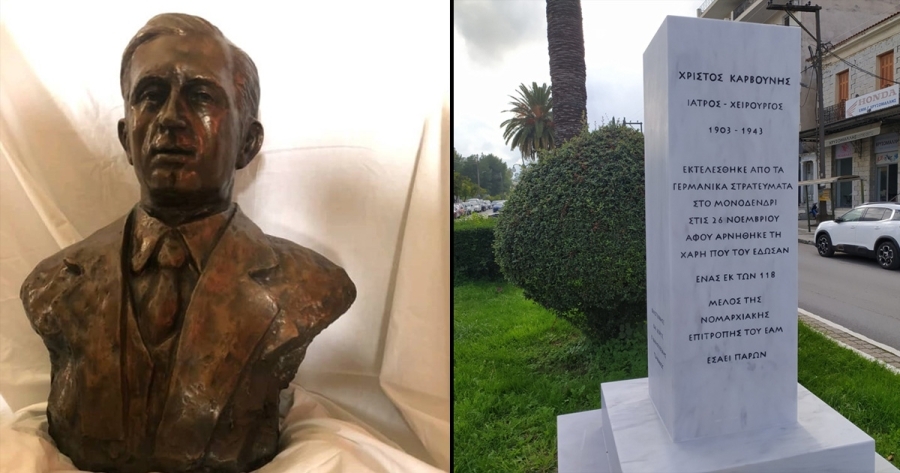
Bust of Christos Karvounis Erected in Sparti as History Sets the Record Straight

Doctor of History, Université catholique de Louvain-la-Neuve
The Municipal Council of Sparti has unanimously decided to erect a monument in honour of Dr Christos Karvounis, the Spartan physician and hero who was among the 118 distinguished sons of the city executed by the German Nazi occupiers on 26 November 1943 at Monodendri.
This act reflects great credit upon the Council. By erecting the bust of Karvounis, crafted by the Spartan sculptor Dimosthenis Tzanakos, in a prominent location upon a marble pedestal, accompanied by a properly documented historical inscription, without alteration or omission, the Council offers to the people of Sparti, to Greece, and to the wider world a contemporary example of patriotism, integrity and humanity, worthy of Sparti’s Leonidean legacy.
It was much the same in 1943, when the radio stations of the Allied nations in the Middle East broadcast across the world the news of the execution of the 118 heroes by the German Nazis.
Christos Karvounis, fluent in German, declined the offer of exemption from the firing squad. With the nobility of his spirit shining through, he asked instead that the youngest of the four Tsivanopoulos brothers be spared. This, too, Hitler’s forces refused. Who can fathom the anguish of their grief-stricken mother, another “Mad Mother” in the sense of Solomos, who, for a long time afterwards, would each morning and evening lay out and fold away her sons’ beds as though they were still alive?
It is worth recalling the most credible historical testimony, that of K. A. Glentis, a theology teacher in Sparti from 1939 to 1946 (2nd ed., Athens 1979, p. 69). Glentis was an ear-witness to a German non-commissioned officer and aide to the Garrison Commander, who, on the very day the 118 were buried, confided the following to him while living in the requisitioned room of Glentis’s home:
“The Doctor—a great patriot. Germany granted him his life, the General said. He refused. One child from four brothers, he said, let him live. No, the German officer replied. This old man then, said the Doctor. Not him either, said the German. Then the Doctor cursed Germany and the Germans, and they shot him down in the face with machine-guns.”
Glentis adds: “My wife and I heard these words from the German himself, accompanied by gestures to help us understand, though in a distorted form.”
All credible historical sources confirm that Karvounis was indeed a member of the National Liberation Front (EAM) and served on the Prefectural Committee of Laconia. To omit this from the inscription would be a grave insult to historical memory. After all, Greek society and the Greek State, after 1974, definitively closed the door on division and the civil-war hostilities perpetuated by the dictatorship of 1967–1974, years that inflicted deep wounds on our country. The restoration of democratic freedoms in the Constitution of 1975, and more than fifty years of stable democratic life since then, affirmed this path. So did Law 1285/1982, recognising the National Resistance against the Occupation (1941–1944), and Law 1863/1989, lifting the legacy of the Civil War in the spirit of National Reconciliation.
Similarly, the statues of the heroic Spartan Hero Konstantopoulou, murdered for her resistance activity by the blood-stained agents of Nazism and commemorated today in Ilioupoli and Piraeus, record in both cases that she was a member of EPON, the youth organisation of EAM. And it is an honour to Sparti that its First Primary School bears her name.
In moments such as these, poetry, art at its highest, cannot but be present. From C. P. Cavafy’s “Thermopylae”:
Honour to those who in their lives
set out and guard their own Thermopylae.
Never swerving from duty;
just and upright in all their deeds,
yet with compassion and with pity;
generous when fortune favours them, and,
when they are poor, still a little generous,
still helping as much as they are able;
always speaking the truth,
yet without hatred for those who lie.
And greater honour still is due to them
when they foresee (and many foresee)
that Ephialtes will appear at last,
and the Medes will finally break through.
Saturday, 15 November 2025
Vale Diamantis Lambrakis (1931-2025)
Born in Pantanassa, Lakonia, on 26 October 1931, Diamantis passed away in Adelaide on 9 November 2025, aged 94 years.
Beloved husband of Koula.
Loved father and father-in-law of George and Antonia; Angelo and Denni.
Cherished Pappou of Kerrie and Lambro, Adam and Stavroula, David and Jo, Ben and Kate, Chad and Amanda, Cassandra and Ryan, Leigh and Stonie, and Jo and Adam.
Adored Great-Grandfather of nine great-grandchildren.
Loved brother and brother-in-law of Helen; Sofia and Christoforos; and Argiro and Telli (dec).
He will be lovingly remembered by family and friends in Australia and Greece.
We extend our heartfelt condolences to the family during this difficult time.
May his memory be eternal.
Monday, 10 November 2025
Pallaconian Brotherhood of Victoria Commemorates OXI Day
“Though miles apart, we remain bound by our Laconian heritage, our love for Greece, and our shared commitment to honour those who fought for liberty and justice.”
On Saturday, 1st of November, our sister club, the Pallaconian Brotherhood of Melbourne and Victoria, held a moving ceremony at the bust of King Leonidas in Sparta Place, Brunswick, to commemorate OXI Day and honour the unyielding courage of Greece during the Second World War.
Members of the Brotherhood, young and old alike, gathered in unity to pay tribute to the heroes of the 28th of October, 1940, those who stood firm and declared a resounding “OXI!” to tyranny and oppression. Their defiance marked a turning point in history, embodying the very spirit of freedom and resilience that continues to inspire Greek people around the world.
The ceremony featured inspiring words from President Chris Paikopoulos, Vice President Miltiadis Paikopoulos, and Youth President Dean Baziotis-Kalfas. Each spoke with passion about the enduring significance of OXI Day and the pivotal role Laconia played in Greece’s wartime struggle. Their reflections reminded all present that the values of bravery, unity, and sacrifice are not merely part of our history; they are living threads woven into our shared identity as Hellenes.
The wreath-laying ceremony brought together representatives from across the Greek-Australian community of Melbourne, including the National Union of Greek-Australian Students (NUGAS), the Pan Arcadians, the Greek Australian Cultural League, the Greek Elderly Citizens Association, the Pallaconian Youth, the Pallaconian Elderly Committee, the Kalymnian Youth, and Councillor Helen Politis, Deputy Mayor of Merri-bek City Council. Their collective presence stood as a testament to the strength, respect, and enduring unity of our community.
From Adelaide, we send our heartfelt congratulations to our Melbourne Pallaconian family for organising such a meaningful and dignified commemoration. Though miles apart, we remain bound by our Laconian heritage, our love for Greece, and our shared commitment to preserving the memory of those who fought for liberty and justice.
Long live Greece! Eternal glory to the heroes of 1940!